

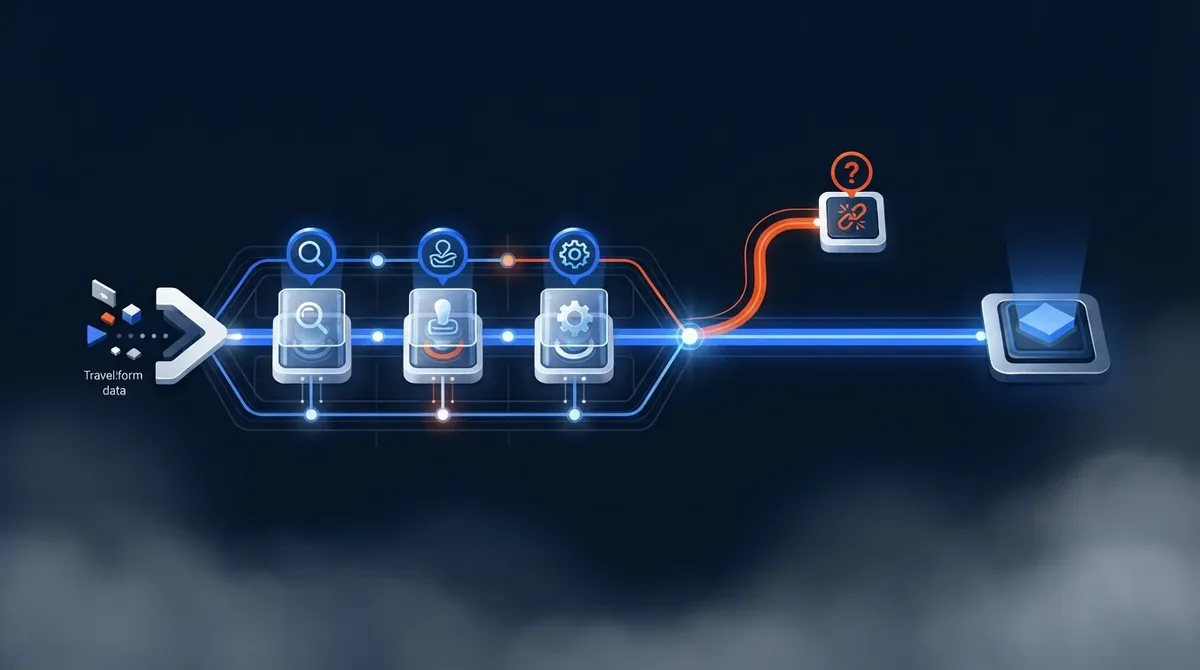
Industry announcements regarding airline Offers, Orders, and New Distribution Capability frameworks often describe high-level retailing visions rather than immediate supplier API availability. For travel platform owners and technical leads, translating these strategic standards into practical software architecture requires looking past broad industry direction. Platform teams must examine the specific mechanics of their suppliers to handle shopping, servicing, cancellations, and financial reconciliation without hidden operational friction. [1]
The core challenge lies in separating official standards governed by bodies like the International Air Transport Association from the actual engineering capabilities exposed by individual airline IT systems. Relying on marketing rollouts without verifying underlying endpoint behavior exposes platforms to silent booking failures, mismatched state synchronization, and unmanaged support overhead. [1]
Understanding the NDC Framework and Governance Reality
The New Distribution Capability is an XML-based data transmission standard governed by the Shop-Order Standards Board to standardize airline offer and order management processes. However, knowing that a standard exists does not tell a technical lead which XML schemas, transport protocols, or profile versions an individual airline currently supports in production environments. Suppliers migrate at varying cadences, meaning two carriers certified under the same broad standard may expose entirely different API endpoints, error formats, and authentication mechanisms. [1]
Platform engineering teams must audit supplier documentation against active test environments rather than assuming uniform feature parity across all connected airlines. When a provider updates its offer generation or order change schemas, downstream parsing logic can fail unless version negotiation and deprecation handling are explicitly engineered into the integration contract. Furthermore, understanding the precise XML namespaces and transport security requirements prevents unexpected parsing errors during peak transaction windows.
Maintaining compatibility across multiple airline schemas requires a modular adapter architecture. Rather than binding core platform logic directly to each carrier endpoint, teams should isolate supplier-specific parsing into dedicated translation layers that normalize inbound offers and outbound order requests into a consistent internal domain model.
Servicing, Changes, and Cancellation Gaps
Shopping and initial booking creation represent only the beginning of a travel platform's operational lifecycle. Post-booking servicing—including schedule changes, ancillary additions, partial cancellations, and refunds—frequently exposes the largest gaps in supplier API maturity. Many airline endpoints support initial order creation while leaving complex exchange calculations or voluntary reissuances to manual agent workflows.
Technical leads must verify whether a supplier API supports automated order amendment or if change requests trigger asynchronous notifications that require durable state tracking. If an airline returns a timeout during a ticket exchange request, the platform must be able to categorize the outcome as an unknown state rather than an automatic failure, preventing duplicate change attempts or accidental double-charging.
Establishing clear workflow boundaries for edge cases, such as involuntary schedule changes initiated by the carrier, ensures that customer notifications and ticket reissuance remain synchronized between the airline ledger and the downstream travel management system.
Identifiers, State Management, and Reconciliation
Moving from legacy passenger name record locators to modern Order IDs changes how platforms track ownership and maintain ledger consistency. An Order ID issued by an airline must be mapped reliably against internal booking references, payment ledger entries, and customer-facing identifiers to prevent split-brain scenarios during disputes.
Reconciliation obligations multiply when suppliers settle transactions through diverse channels, Bank Billing Settlement Plan mechanisms, or direct merchant-of-record models. Platform databases must store raw supplier responses, idempotency keys, and transaction version numbers so finance and operations teams can investigate discrepancies without guessing whether a payment settlement corresponds to an active or canceled order segment.
Hypothetical Scenario: Managing Supplier Timeouts on Order Changes
Consider a hypothetical travel platform processing a last-minute flight date change for a corporate traveler via a supplier NDC API. The inputs include the active Order ID, updated segment availability, and an agreed-upon fare difference payment token. The intended behavior is for the supplier endpoint to commit the change, return a confirmed order version update, and trigger a synchronized ledger adjustment.
A plausible failure in this scenario occurs when the airline API connection drops immediately after debiting the payment method but before returning the updated Order XML payload. The practical response requires halting automated retry loops, inspecting operational audit logs for idempotency markers, and utilizing secure supplier inquiry endpoints to confirm whether the change was persisted on the airline ledger before notifying the user or initiating a manual support handoff.
Concrete Verification Checks Before Integration Sign-Off
Check one evaluates supplier endpoint error handling under simulated network degradation, requiring the integration layer to successfully isolate timeout exceptions and prevent duplicate retry executions for non-idempotent financial actions.
Check two examines permission and schema validation, ensuring that malformed or unauthorized responses from airline feeds are rejected securely without exposing internal stack traces or corrupting local booking databases.
Check three validates exception routing, verifying that unmatched settlement records or ambiguous order status changes are routed to designated operational queues with complete source payloads for human review.
Tradeoffs and Operational Costs of Direct Integration
Building direct integrations against multiple airline offer and order APIs provides fine-grained control over commercial terms and merchandising, but it introduces substantial ongoing maintenance overhead. Every airline schema update, breaking version change, or altered servicing policy requires dedicated engineering effort to maintain adapter code and regression tests.
For platforms with limited engineering capacity or diverse global supplier needs, aggregating through specialized distribution partners can reduce immediate maintenance friction. However, that choice introduces dependency risks and limits direct visibility into underlying supplier error states. Leadership teams must weigh the recurring cost of adapter maintenance against the operational risk of supplier black-box failures.
Practical takeaways
Verify actual supplier API capabilities and test environments rather than relying solely on high-level industry standard roadmaps. [1]
Design integration contracts to handle ambiguous timeouts and non-idempotent retries safely without risking duplicate customer charges.
Establish durable state tracking and explicit reconciliation queues for post-booking servicing, schedule changes, and refund settlements.