

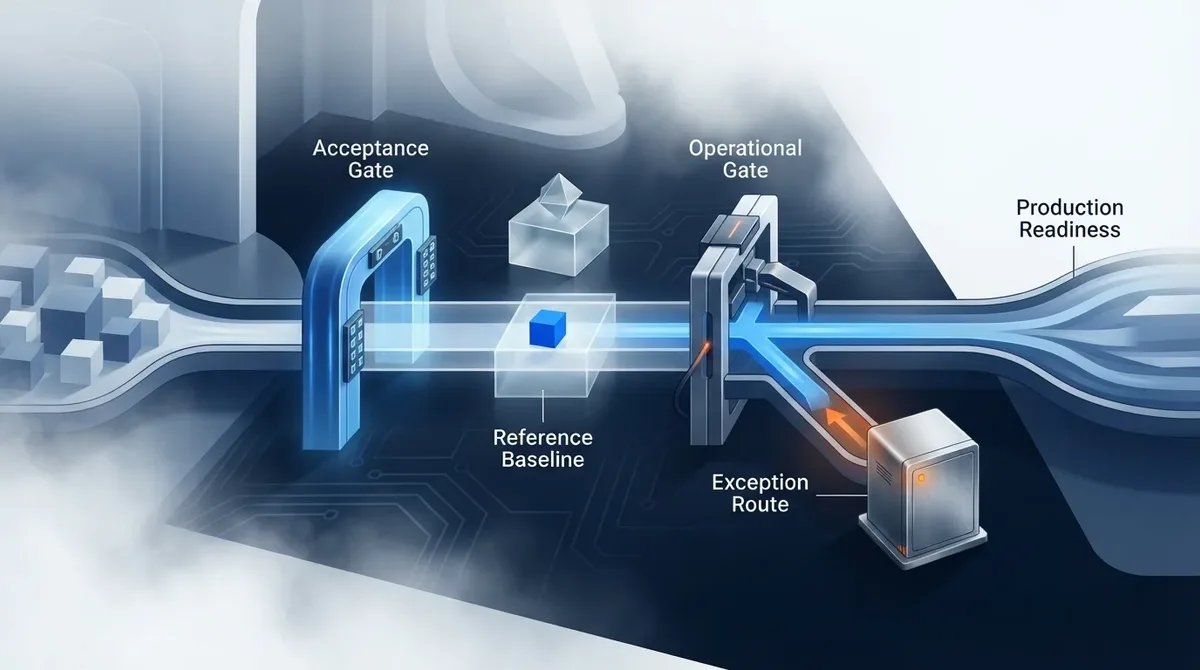
Initial evaluations of applied machine learning often rely on polished proof-of-concept demonstrations running against pristine sample inputs. Yet, these controlled walkthroughs provide negligible evidence concerning system resilience under chaotic enterprise incoming streams, anomalous edge cases, unpredictable processing overhead, or safe failure handling during unexpected traffic surges.
Advancing an intelligent document engine from an isolated sandbox environment into core business operations demands strict quality gates that mirror mature software engineering standards. This guide provides technical leaders with an actionable methodology to establish reliable release criteria using a hypothetical invoice and contract reconciliation scenario.
Curating the Representative Test Set and Baseline
Before evaluating an automated document pipeline, engineering leads must assemble a robust corpus reflecting authentic operational variation rather than idealized test files. This dataset ought to encompass historical defects, such as low-resolution scans, corrupted attachments, conflicting tax figures, missing metadata fields, and irregular vendor layouts collected during routine business cycles.
Establishing a quantitative baseline against this corpus lets teams measure extraction task success relative to historical human performance. Proceeding without this baseline leaves accuracy metrics unverified, rendering the system vulnerable to regression whenever prompts, model weights, or retrieval parameters undergo updates.
Product owners and technical staff should collaboratively tag each entry with explicit target fields, allowable numerical boundaries, and defined error categories. This curated dataset acts as the single source of truth for repeatable regression testing throughout the lifecycle.
Separating Task Correctness from Action Safety
A frequent architectural oversight in intelligent workflow design involves treating transcription accuracy and transaction execution as a single operational step. A model might extract line items with high precision while misinterpreting a complex rebate clause, inadvertently triggering an unauthorized financial credit that breaches corporate governance controls.
Production readiness requires complete separation between data extraction capabilities and transactional write authorities. Dangerous or consequential system actions must remain sequestered behind deterministic permission checks, strict input schema validation, and mandatory human sign-off boundaries.
By enforcing this architectural partition, the surrounding application layer can reject malformed payloads even if the extraction layer hallucinates values, preventing corrupt updates from reaching databases or external ledgers.
Hypothetical Scenario: Multi-Page Invoice Processing
To ground these principles, examine a procurement workflow where an automated system parses multi-page supplier invoices to generate draft payment requisitions. Incoming payloads arrive via email ingestion as variable PDF documents containing mixed tax rates, handwritten purchase order annotations, and scanning artifacts.
The intended workflow behavior extracts line items, reconciles them against active ERP purchase orders, and queues clean records for supervisor approval. A plausible failure occurs when a supplier includes an ambiguous credit memo referencing a canceled order, causing the parser to output a zero-dollar line item that distorts the net calculation.
The correct operational response involves an automated abstention rule that halts processing, flags the arithmetic anomaly, and routes the transaction to an exceptions queue rather than committing erroneous data to financial records.
Evaluating Abstention Cases and Human Escalation
Enterprise automation must gracefully recognize its own limitations. Acceptance test suites should actively target abstention scenarios where confidence metrics fall below tolerance, mandatory fields are missing, or logical contradictions exist across document sections.
Human-in-the-loop review interfaces require thorough testing to ensure operators receive adequate contextual evidence. Reviewers need side-by-side visibility linking the original document region, the parsed value, and the specific validation error to resolve items efficiently.
Tracking review cycle times and correction frequencies helps engineering teams diagnose whether extraction failures stem from poor source documents, imprecise prompts, or ambiguous validation business rules.
Testing Permission Denial, Ambiguous Data, and Retries
Rigorous acceptance protocols must validate edge cases across permission boundaries, ambiguous data structures, duplicate transmission retries, and operator handoffs. For instance, if an API client times out immediately after writing a record, a retry mechanism must verify existing state rather than duplicate transactions.
Permission boundaries require stress testing by attempting cross-tenant reads or unauthorized write actions using restricted service credentials. When ambiguity or permission violations occur, the workflow must fail securely without disclosing sensitive metadata or stack traces.
Simulating network partitions during active database writes confirms that idempotency keys successfully suppress duplicate entries and maintain state consistency across distributed service boundaries.
Concrete Release Checks and Decision Gates
Promotion decisions to production must rely on objective gating criteria rather than subjective stakeholder impressions. Engineering, operations, and security teams must evaluate explicit test outcomes prior to authorizing live deployment.
Check one measures field extraction precision against the golden dataset, requiring an example threshold of ninety-eight percent correct extractions for required financial attributes in our scenario before approval.
Check two audits exception routing behavior, verifying that one hundred percent of documents containing arithmetic discrepancies trigger manual review queues rather than bypassing rules. Check three tests idempotency safeguards under simulated network drops.
Tradeoffs, Limitations, and Operational Costs
Building comprehensive acceptance test suites demands substantial upfront engineering effort. Assembling historical datasets, maintaining regression pipelines, and configuring specialized review queues require dedicated cross-functional coordination.
Furthermore, strict abstention thresholds and frequent escalation paths can restrict automated throughput during initial deployment phases. Organizations must balance these operational frictions against the long-term liabilities of data corruption and compliance failures.
Where document volumes are minimal or error consequences remain negligible, lightweight validation may suffice. For high-volume financial workflows, however, omitting rigorous release gates shifts unmitigated technical debt directly onto downstream support teams.
Practical takeaways
Construct domain-specific test sets using historical edge cases rather than relying on clean demo files or vendor benchmarks.
Isolate probabilistic data extraction from deterministic execution layers to guarantee transaction safety and enforce permissions.
Verify automated abstention triggers and human review workflows to ensure ambiguous records require manual verification.
Establish objective release gates covering accuracy baselines, retry idempotency, and security boundaries prior to production deployment.