

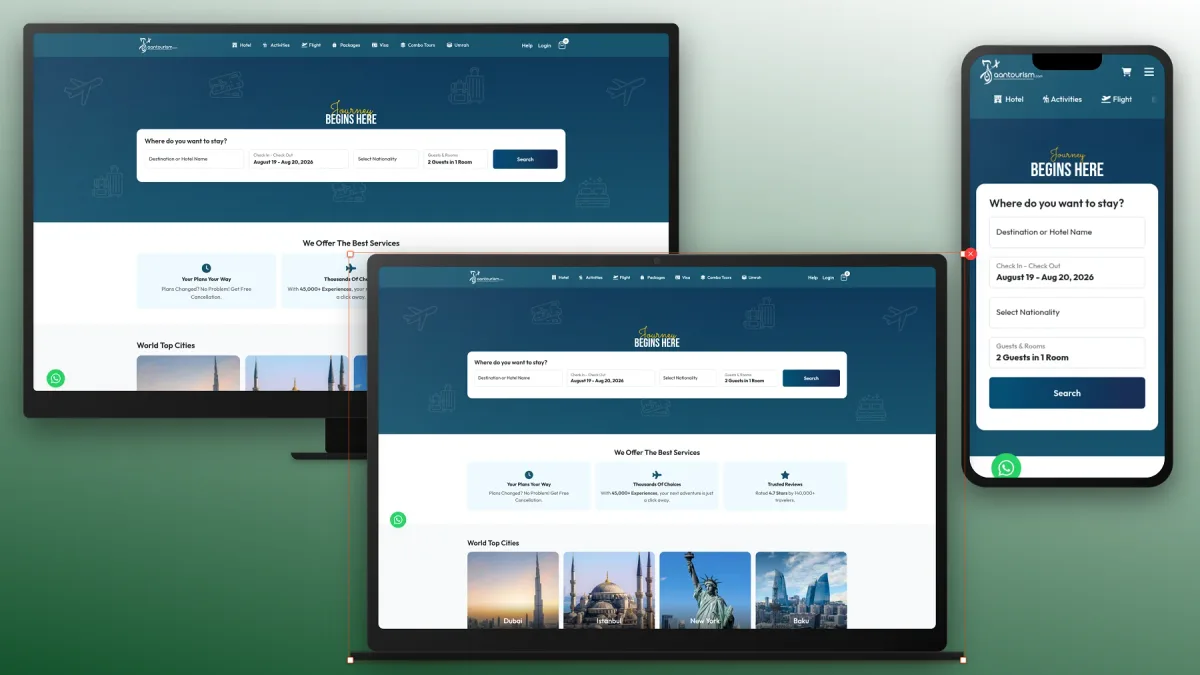
In the global travel and tourism sector, operating across multiple national markets frequently introduces severe systemic friction. When direct consumers, wholesale travel agents, and internal administrative staff rely on disconnected software applications, the resulting architecture produces administrative overhead, delayed service delivery, and restricted enterprise scalability. Enterprises attempting to expand into new geographic territories often discover that ad-hoc software additions fail to support intricate, cross-departmental business processes.
This project spotlight analyzes the foundational workflow design challenges encountered by AAN Tourism and the engineering strategy executed by Xtreme Systems Solutions. Rather than treating retail customer portals, commercial agent tools, and back-office financial accounting as separate functional entities, the initiative prioritized the construction of a cohesive, centralized travel technology ecosystem. Below, we examine the documented business obstacles, the deployed multi-channel capabilities, and the operational value of a unified system architecture.
Diagnosing Operational Fragmentation in Cross-Border Travel
AAN Tourism faced a complex operational impediment: managing multi-country travel services through entirely disconnected customer-facing, agent-facing, and back-office systems. Within an international travel environment, disparate software deployments inevitably create severe workflow bottlenecks. Direct retail customers require responsive, intuitive booking channels for diverse products including flights, hotels, activities, packages, Umrah services, and visas. Simultaneously, B2B travel agents demand customized pricing tiers, dedicated account management tools, and specialized order workflows.
When these distinct user journeys operate independently from internal administration, supplier networks, CRM databases, and accounting frameworks, administrative teams are forced to manually reconcile data across incompatible platforms. This architectural separation inhibits regional expansion, slows down inventory updates, and amplifies the risk of critical operational errors. Resolving these structural challenges required a comprehensive re-engineering of the underlying business workflows, guaranteeing that frontend user requests tied directly into a consolidated backend infrastructure.
Architecting a Centralized Travel Technology Ecosystem
To systematically eliminate these operational silos, Xtreme Systems Solutions engineered comprehensive B2C and B2B platforms anchored by cross-platform Android and iOS applications built using Flutter. These mobile applications guarantee that both retail consumers and commercial partners maintain reliable, consistent access to travel inventory and account management controls on the move. To address high-volume inventory discovery, the platform integrated an ElasticSearch-powered travel inventory search mechanism, enabling rapid retrieval of complex travel offerings across multiple parameters.
Beyond frontend booking interfaces, the delivered system incorporates centralized administrative and operational modules. The technical architecture unifies supplier management, CRM data, accounting, human resources, content management, offline sales tracking, and AI-assisted SEO workflows into a single operational hub. By centralizing these diverse functions utilizing a robust technology stack encompassing Python, TypeScript, PHP, Laravel, CodeIgniter, AWS, Cloudflare, Firebase, and MySQL, the platform provides the necessary administrative control to support wide-ranging international travel services.
Delivering Practical Scalability and Administrative Control
The practical value of this integrated ecosystem resides in its capacity to streamline day-to-day administrative management while establishing a sustainable foundation for future business growth. By consolidating B2C, B2B, and mobile operations into a single cohesive environment, internal personnel gain clear, unhindered visibility over supplier relationships, financial transactions, and customer histories without toggling between disparate legacy software applications.
Furthermore, the modular architecture provides a scalable framework capable of accommodating additional regional markets and service expansions over time. Through disciplined workflow design and resilient technical infrastructure, Xtreme Systems Solutions equipped AAN Tourism with an enterprise digital backbone capable of supporting sustained, high-volume commercial operations.
Practical takeaways
Unified workflows eliminate the friction caused by operating isolated customer, agent, and back-office systems.
Centralized administrative modules—spanning CRM, accounting, suppliers, and HR—reduce manual reconciliation effort in multi-country operations.
Cross-platform mobile applications built in Flutter provide consistent touchpoints for both B2C travelers and B2B agents.
Advanced search infrastructure, such as ElasticSearch, is essential for delivering rapid inventory discovery across complex travel catalogs.
A scalable technical foundation allows travel organizations to expand into new geographic markets and introduce additional service lines smoothly.
Sources and further reading
[1] AAN Tourism