

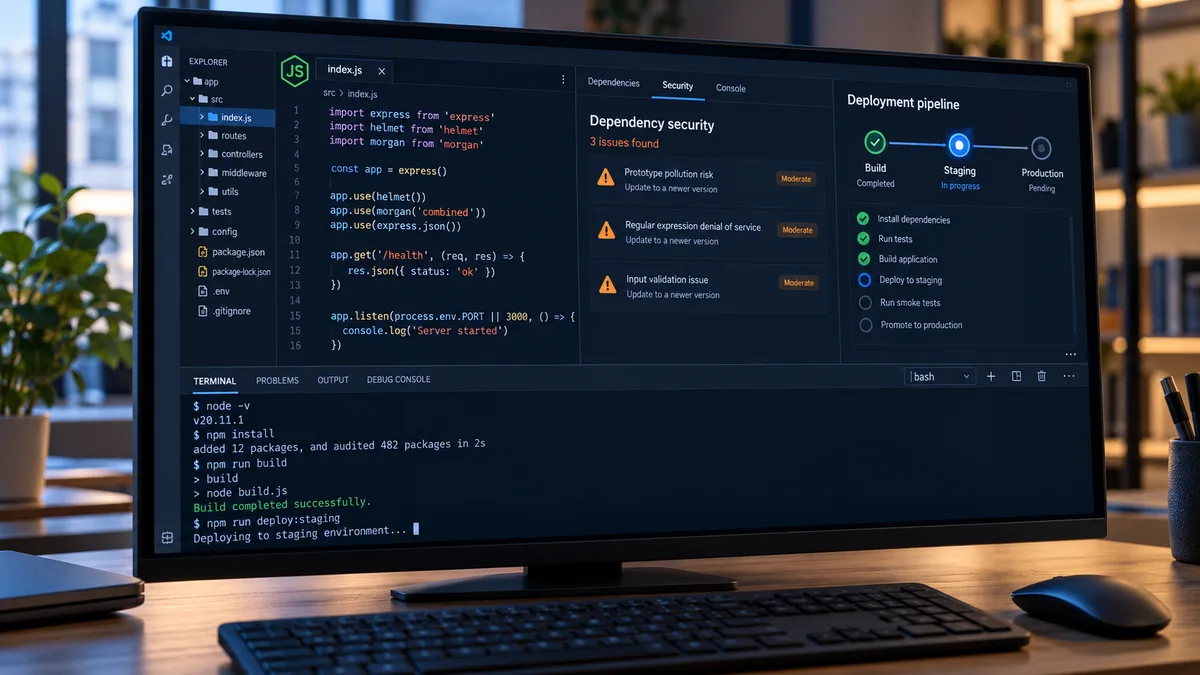
On October 21, 2026, the Node.js project published security updates for its 22.x, 24.x and 26.x release lines. The advisory includes a high-severity Brotli decoder flaw, CVE-2026-111497, that can affect applications decompressing attacker-supplied data through node:zlib. [1]
For application owners, the decision is how to update affected deployments promptly while checking that critical business journeys still work. A controlled upgrade starts with an accurate runtime inventory, identifies exposed data paths, and defines the evidence required before each deployment advances. This article outlines a practical assessment and rollout scope; the recommendations are not vendor-mandated deadlines.
What the October Security Release Changes
The Brotli defect can allow malformed compressed input to corrupt process memory, potentially causing a crash, memory disclosure or remote code execution. The relevant condition is whether untrusted Brotli data reaches the Node.js decoder, rather than whether an application simply uses Node.js. [1]
Start by identifying which runtime version each application actually executes. Check the deployed container or host, build environment and scheduled workers. A developer laptop's version does not establish what production runs. Record the application owner and deployment location so that each upgrade has an accountable implementation path.
The verified release notes identify Node.js v22.23.4 and v24.22.1 as security releases. Both include OpenSSL 3.5.9 and c-ares 1.34.9; v22.23.4 includes Undici 6.29.1, while v24.22.1 includes Undici 7.30.1. Select the appropriate patched version within your supported release line and check for subsequent updates before deployment. [2] [3]
Assess Exposure Across the Complete Data Path
Trace how compressed data enters each service. Review request parsers, upload processing, integration adapters and background jobs rather than checking only public HTTP endpoints. Identify whether the Node.js process receives compressed bytes and which component performs decompression. Mark uncertain paths for investigation rather than treating missing information as evidence of safety.
A reverse proxy or private subnet should not be treated as an automatic exemption. Verify the proxy's actual behavior and consider alternative routes, such as uploaded files or queued messages. Prioritize services that process untrusted compressed input, while retaining a documented upgrade plan for the remaining affected deployments.
The assessment should produce a named owner, a proposed target runtime and a short explanation of priority for each workload. Where a temporary restriction is feasible, document its scope, operational impact and expiry. Temporary controls support the upgrade process; they do not replace the patched runtime or justify an indefinite deferral.
Include DNS and TLS Behavior in the Review
The same advisory describes DNS name truncation involving embedded NUL bytes and TLS hostname-verification defects. Affected release lines differ between individual issues, so assess them separately against the official advisory. These findings matter when reviewing outbound integrations and hostname-validation paths. [1]
Include services that fetch customer-supplied URLs, dispatch webhooks or connect to external APIs in the assessment. Check the sequence of parsing, validation and resolution instead of assuming that an allowlist covers every representation of a hostname. Use controlled regression cases derived from the relevant upstream fixes, without directing test traffic toward unauthorized systems.
When documenting a test, distinguish a literal NUL byte from the characters in a percent-encoded string. Whether decoding occurs depends on the application path. Record the input representation, the component receiving it and the expected application response so that the test proves something specific and repeatable.
Verify Dependencies Without Assuming Breakage
Documented dependency updates are a reason to test relevant application behavior, not evidence that an upgrade will break native addons or cryptography. Rebuild the application using its normal dependency installation process and target container image. Check native modules, certificate configuration and third-party integrations that are important to the application.
Exercise representative outbound requests, timeout handling and connection reuse under a workload resembling normal operation. Compare error rates, latency and memory with an agreed baseline. Investigate material changes instead of applying an arbitrary socket-reuse percentage that has no established relationship to the application's requirements.
Keep the runtime security update separate from optional feature work or unrelated dependency upgrades where practical. A smaller change is easier to review, validate and investigate. Record any additional changes that are genuinely required, together with the evidence supporting their inclusion in the release.
Define Application-Level Acceptance Checks
For a hypothetical telemetry ingestion service, the assessment might identify untrusted compressed uploads as an exposed path. The test plan should connect that finding to controlled verification of the patched deployment. It should not claim that a particular exception, HTTP status or recovery sequence is guaranteed by Node.js alone.
Check one: in an isolated test environment, exercise decompression failure handling with appropriate regression fixtures. Confirm that the application handles errors through its intended response or job-failure path, records useful diagnostics and remains operational. The application team must define the expected HTTP response or queue outcome; the runtime update does not choose that behavior for the application.
Check two: test the application's hostname-validation and outbound connection paths using approved cases relevant to the advisory. Confirm that unacceptable inputs are rejected before an unauthorized connection occurs. Include the configured error handling and audit trail in the acceptance criteria.
Check three: run representative integration traffic and compare observed latency, errors, resource use and connection behavior with the baseline. Choose the duration and acceptance thresholds according to workload characteristics and operational risk, and label illustrative values as examples rather than established production requirements.
Build an Upgrade Inventory and Deployment Runbook
Use a short inventory that connects technical findings to deployment decisions. A practical record should contain the following fields:
- Service and accountable owner.
- Observed production runtime and proposed patched target.
- Relevant input paths, integrations and exposure findings.
- Verification checks and acceptance thresholds.
- Deployment window, observation period and rollback decision owner.
Example entry: a telemetry service processes externally supplied compressed uploads, so its owner prioritizes the runtime update and validates decompression error handling plus its downstream integration.
How to use: review each entry with the application owner, agree the rollout sequence, then record the outcome of each verification gate. Any example deadline is an internal planning choice, not a vendor requirement. Define failure thresholds and a recovery decision before rollout begins. Returning to an older image may restore vulnerable code, so include containment and forward-fix options when assessing rollback.
Scope a Focused Application Upgrade Engagement
A useful professional assessment should resolve uncertainty about affected deployments, integration dependencies and release verification. The objective is a prioritized implementation plan that can be reviewed and executed by the application team, with explicit ownership and acceptance criteria.
For an initial scoping discussion, prepare dependency manifests, Dockerfiles or runtime definitions, a high-level service inventory and the business journeys that must remain available. Xtreme Systems Solutions can use these inputs to define an application upgrade engagement covering exposure review, implementation scope, regression checks and a deployment runbook. Discuss your application upgrade scope to establish the appropriate next step.
Practical takeaways
Identify every deployed Node.js runtime and prioritize workloads that process untrusted compressed data; do not limit the inventory to public web servers.
Keep all affected deployments in the upgrade plan, with owners and verification gates. Private networking and proxies require assessment rather than automatic exemption.
Check the advisory's affected release lines for each issue, including DNS and TLS findings, instead of treating all vulnerabilities as identical. [1]
Scope the work around concrete inputs and outputs: runtime inventory, priority decisions, regression evidence and a deployment/recovery runbook.
Sources and further reading
[1] Node.js — Wednesday, October 21, 2026 Security Releases