

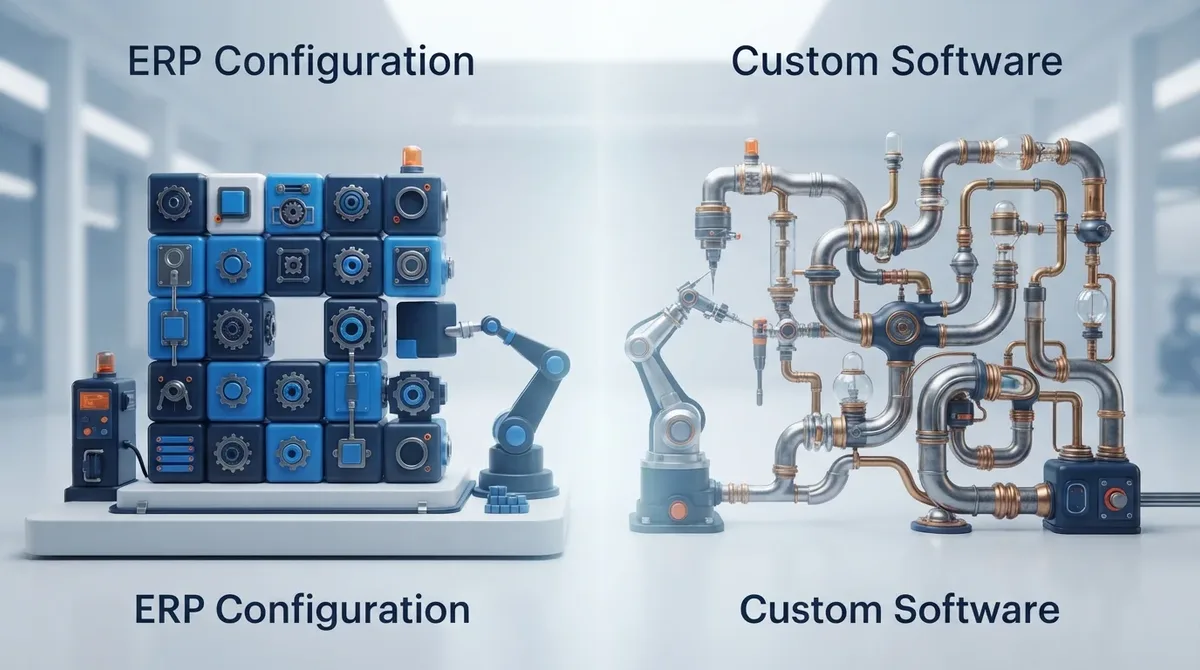
Evaluating whether a critical business workflow belongs inside an off-the-shelf enterprise resource planning configuration, a tailored extension, or entirely custom software is rarely straightforward. Operations and finance leaders frequently face pressure to minimize upfront development costs by forcing complex operational rules into generic platform templates. When those templates fail to accommodate core business mechanics, teams resort to disconnected spreadsheets, manual reconciliation, and fragile scripts that obscure operational truth.
Choosing the wrong delivery vehicle creates compounding technical debt and hidden operational overhead. Configuration that seems fast during a software demonstration can harden into an inflexible bottleneck when commercial terms, regional tax rules, or multi-step exception paths change. Conversely, building custom software without a strict scoping framework risks reinventing core accounting, identity, and auditing features that an established platform manages natively.
To establish a defensible scope before engaging a delivery partner, organizations need an objective framework. This guide examines how to evaluate workflow fit, manage exception handling, assign ownership of business rules, balance long-term operating burdens across the three primary architectural choices, and structure your team's approach to technical governance.
Evaluating Workflow Fit and Core Differentiation
Every enterprise software decision starts with a fundamental question: does the underlying workflow represent a genuine market differentiator, or is it an undifferentiated operational necessity? Standard accounting, basic payroll, and general ledger reconciliation follow heavily regulated, standardized practices. For these functions, configuring an existing platform is almost always the correct path because compliance and auditing rules are already codified by the vendor.
However, proprietary pricing models, unique multi-tier fulfillment logistics, or specialized customer onboarding pipelines often constitute the core value of an operation. Forcing these workflows into rigid out-of-the-box data models requires excessive customization, where developers fight against the underlying platform architecture to achieve basic business outcomes. If a process requires specific state transitions that the vendor data schema simply cannot represent, configuration ceases to be efficient and becomes a liability.
Organizations must therefore audit their operational workflows before selecting a platform. Mapping out each distinct lifecycle stage helps separate routine record-keeping from proprietary competitive advantages, ensuring that development effort is directed where it delivers maximum business value rather than wasted on fighting standard software constraints.
The Trap of Over-Configuration and Extension Coupling
When standard configuration falls short, teams often turn to platform extensions, plugins, or low-code customization layers. While these mechanisms promise the best of both worlds—standard core infrastructure combined with tailored logic—they frequently introduce tight operational coupling. If an extension relies on undocumented database views, fragile API hooks, or proprietary scripting engines, subsequent platform upgrades can break core business logic without warning.
Furthermore, diagnosing failures in heavily extended systems requires specialized knowledge of both the underlying platform and the custom code layer. Operational teams lose visibility when errors occur inside black-box execution environments, making it difficult to determine whether a failed transaction stems from platform throttling, data validation failure, or custom script logic. Before approving an extension, architects must verify that monitoring, logging, and error queues remain transparent and fully accessible.
Maintaining a clean boundary between core platform tables and custom extension code is essential for long-term maintainability. When boundaries blur, technical debt accumulates silently, turning routine vendor patches into major engineering incidents that require costly manual intervention.
Hypothetical Scenario: Fulfilling Custom Wholesale Orders
Consider a mid-sized wholesale distributor evaluating how to handle a newly acquired B2B contract requiring tiered volume discounting, dynamic pallet-level inventory allocation, and automated customs documentation. The existing enterprise resource planning tool offers standard inventory tracking and invoice generation, but lacks native support for multi-location partial allocation rules combined with customer-specific commercial terms.
The operations team outlines three potential approaches. The first is pure configuration: forcing the custom rules into standard sales order types using custom fields and manual workarounds. The second is an integrated extension: building a microservice that intercepts order creation events, applies the custom allocation logic externally, and writes the resulting fulfillment plan back into the enterprise platform. The third is custom software: building a dedicated order orchestration service that integrates directly with warehouse and accounting APIs.
A plausible failure in the extension approach occurs when an external API timeout happens after the inventory allocation service reserves stock but before the enterprise platform records the fulfillment commitment. Without an idempotent transaction state, a subsequent retry could allocate the same inventory twice, resulting in overselling and costly fulfillment errors. A mature architecture requires explicit idempotency keys, durable state tracking, and clear operational runbooks to handle unknown outcomes safely.
A Practical Discovery Checklist for Operations Leaders
To determine whether your organization needs configuration, an extension, or custom software, run a rigorous discovery process before writing code or purchasing licenses. Evaluate the frequency of edge cases, the complexity of data reconciliation, and the true cost of manual intervention across all participating departments.
Question 1: Who owns the business rule when commercial policy changes? If the rule is dictated by external statutory regulations, configuration is preferred. If the rule evolves continuously based on competitive strategy, a more flexible custom boundary may be warranted.
Question 2: What happens when an integration or processing step fails midway? If a failure leaves records in an ambiguous state that requires manual database intervention, the architecture lacks sufficient state management and recovery tooling.
Question 3: Can the proposed system cleanly handle exception queues, duplicate retries, and human handoffs? A robust enterprise application must provide visible queues for unmatched transactions, permission denials, and delayed updates without relying on informal spreadsheets.
Balancing Total Operating Burden and Risk
Every technical choice carries an ongoing operational cost. Configuration shifts maintenance overhead to software vendors, but introduces risk when vendors deprecate features or alter licensing models. Custom software places full ownership of security patches, infrastructure uptime, and code maintenance on internal engineering teams or delivery partners.
Organizations must weigh these burdens against their internal technical capacity. Building custom software without an experienced operations team to maintain it creates an unsustainable technical debt burden. Conversely, bending an inflexible ERP platform to fit every unique nuance of a complex operating model creates an administrative burden that frustrates staff and slows business growth.
Leadership teams should evaluate total operating cost not just through initial licensing or development fees, but by calculating the ongoing cost of exception management, support overhead, and future upgrade friction over a multi-year horizon.
Practical takeaways
Prioritize configuration for standardized, heavily regulated functions like general accounting, where vendor compliance reduces internal risk.
Treat platform extensions with caution; ensure that custom scripts do not create tight coupling that breaks during vendor upgrades.
Evaluate custom software development only when unique workflows represent a core competitive differentiator and standard tools require excessive workarounds.
Insist on explicit state management, idempotency, and visible exception queues for any integration or custom workflow before production release.